The Birth of a Legend
Otto Geleng’s Risky Gamble
A Life-Changing Love Story
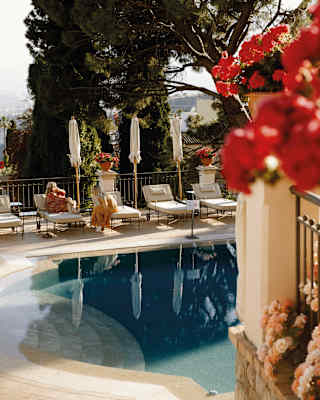
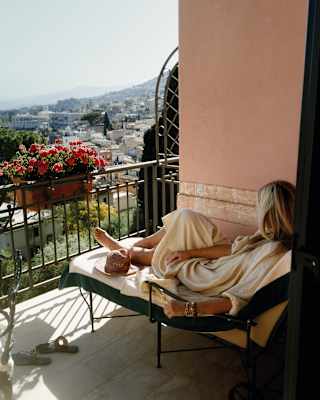
DH Lawrence, Truman Capote And Madonna
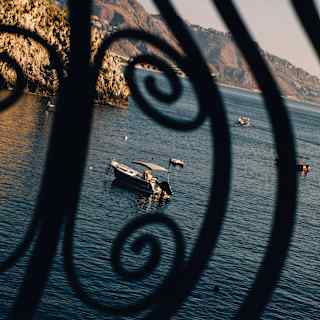
Author
Delilah Khomo is the Travel Editor at Tatler magazine.
Grand Hotel Timeo has its iconic lures. It has always had the prize location, with a discreet bridge from the hotel that takes you straight backstage to one of the antique wonders of the world. A vital call on any version of the Grand Tour, thanks to Taormina’s remarkable Greek Theatre, which the famed writer Johann Wolfgang Von Goethe so romantically documented in his seminal book, Travel in Italy, stating: “No audience in any other theatre ever beheld such a view.”
You could say that Goethe first put Taormina on the map in 1787 when he wrote about this important archaeological site. And in doing so, started to create waves around Taormina, making it the focal point of the island. At around this time, with the first slow trickle of highly cultured tourists, there was no hotel accommodation as such in the town, which was home to mainly fishermen, farmers and shepherds. So how did this titan of glamour and Grand Hotel come to be the international face of the city, its smoothest operator, and the stage set for Sicily?
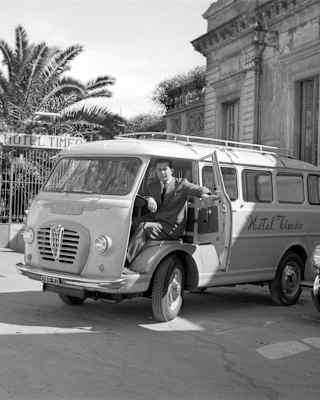
The hotel’s story begins as a somewhat enticingly low-key affair. The original founder of this extraordinary hotel dynasty was Don Francesco La Floresta, who in 1850, decided to rent rooms from his house — the newly created guesthouse, Timeo, was affectionately named after Tauromenion, the son of the founder of the Greek city in 358BC. Ahead of the zeitgeist, Don Francesco could sense the town had the potential to become an enduringly fashionable resort and so set about creating his own atmospheric inn, from his family home.
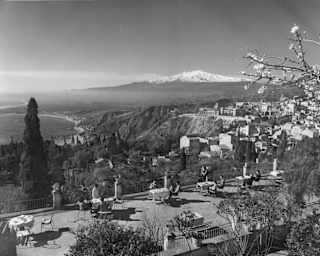
Taormina quietly became a destination for painters, who could travel around the island and capture the extreme beauty of what they saw there: a dreamscape, with snow-covered Etna smoking in the distance, alongside the pale pink almond blossom and wild spring flowers that would carpet the surrounding meadows — and most importantly, the classical ruins of Magna Graecia that remain scattered across the island.
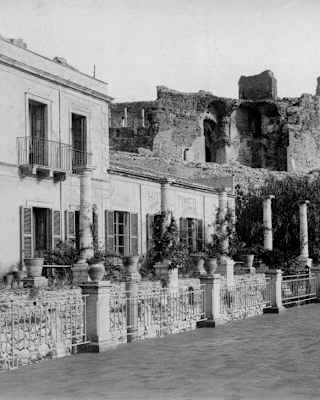
It had started to become one of the most creatively-inspiring places on earth, a rich visual feast, so much so that Professor Biermann (of the Royal Academy of Berlin) took full advantage of creating a body of work, mainly watercolour prints. His painting of Taormina’s Greek Theatre particularly touched one of his students, Otto Geleng. The German painter had a dream and became enchanted by Taormina’s beauty, after seeing a watercolour painting of his professor. And so after finishing his studies, he made his dream a reality and set off on his own expedition to Taormina, lodging with Don Francesco to see the famous Greek Theatre which had made such an impression on him.
Geleng returned back home with a whole new portfolio of rich work, which seriously impressed his professor, who advised him to take his work to Paris. But the paintings were not well received by the French critics, who dismissed his work as a complete mannerist fantasy — a snow-covered volcano depicted near blossoming almond trees seemed like far-fetched artistic liberty to them. But Geleng insisted that he had only painted what he saw and to prove his point, challenged his critics to come to Taormina and compare his paintings with the actual landscapes. If they disagreed with what they saw, Geleng would cover their accommodation and travel. However, if the landscapes were as Geleng had painted, they would have to buy his work and promote Taormina in the press.
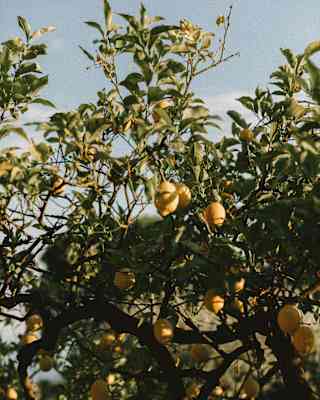
I’m sure when Otto Geleng brought the critics there, they must have had to keep pinching themselves, checking that they were not daydreaming their way into a history book or painting. Geleng won the bet and in some ways forever changed the course of Taormina and the Timeo’s history, propelling it into stardom as an elegant winter hotspot retreat. With the sale of his family’s citrus plantation, Don Francesco La Floresta bought another building right below the Greek Theatre, and slowly started to expand his lodgings with five more bedrooms.
Over a decade later, Don Francesco and his son Giuseppe added even more rooms. Soon becoming a hideaway with an excellent pedigree, visitors would come in the winter to savour the mild weather — take Lady Florence Trevelyan, the aristocratic English rose who ended up taking over a whole floor of rooms, seeking to redecorate the hotel to make herself (and her five dogs) feel even more at home. Timeo was where Lady Trevelyan would savour the peaceful energy of the Greek ruins, often walking along the coast to the Isola Bella beach.
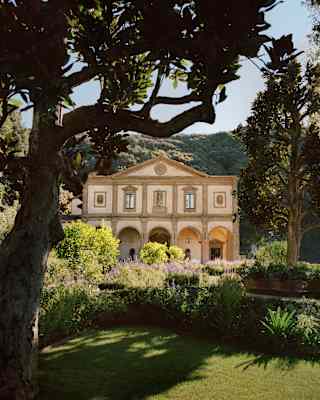
After one of her dogs became seriously unwell, Professor Cacciola stepped in and saved the pet. Seduced by the place, Lady Trevelyan fell in love with the local doctor and gave up her life in England to marry him. She moved into her husband’s large house nearby and spent most of her time tending to the hotel’s gardens, in the wonderfully sprawling park linking the two properties. Lady Trevelyan planted glorious flower arrangements, which became the foundations of the Grand Hotel Timeo’s gardens that remain today.
I’m sure when Otto Geleng brought the critics there, they must have had to keep pinching themselves, checking that they were not daydreaming their way into a history book or painting. Geleng won the bet and in some ways forever changed the course of Taormina and the Timeo’s history, propelling it into stardom as an elegant winter hotspot retreat. With the sale of his family’s citrus plantation, Don Francesco La Floresta bought another building right below the Greek Theatre, and slowly started to expand his lodgings with five more bedrooms.
Richard Wagner made it to Taormina, a year before he died. When Kaiser Wilhelm II arrived in 1904, he promptly abandoned his yacht to occupy the Grand Hotel Timeo — all of it. Soon, Timeo turned into a major hotel that would take the exuberant decadence of the Belle Epoque to previously unimaginable heights in Sicily.
Over its 150-year history, Timeo appears to have turned into an artists’ paradise and destination for the more cerebral realms of celebrity, after literary artists took residence in the hotel from the late 19th century onwards. Nature-lover DH Lawrence found meditative peace in the gardens of Timeo, fuelling his imagination to write the classic Lady Chatterley's Lover. Legend has it that the novel was inspired by a chance encounter with Lady Trevelyan in the hotel’s verdant oasis. He began to pen his novel from the hotel’s terrace, which gave this prized point the title of “Literary Terrace”.
I’m sure when Otto Geleng brought the critics there, they must have had to keep pinching themselves, checking that they were not daydreaming their way into a history book or painting. Geleng won the bet and in some ways forever changed the course of Taormina and the Timeo’s history, propelling it into stardom as an elegant winter hotspot retreat. With the sale of his family’s citrus plantation, Don Francesco La Floresta bought another building right below the Greek Theatre, and slowly started to expand his lodgings with five more bedrooms.
Oscar Wilde fell in love with the residence’s classical beauty. Tennessee Williams delved into the gracious world of Timeo, relishing in Taormina’s renowned liberal, sensual and culturally open attitude. Truman Capote followed suit, spending two years at Timeo while he wrote Breakfast at Tiffany’s. The glitterati era began shortly after when it became a dolce vita hotspot thanks to the launch of the Taormina film festival in the 1950s.
Throughout the past 150 years, this place has been a magnet for kings, princes and grand dukes, not to mention Hollywood’s celestial set. And although the hotel changed hands from the original La Floresta family to another Sicilian owner, later becoming part of the Belmond Group, through all its incarnations it’s amassed a vast quantity of stardust that this hotel sprinkles on guests, keeping them dreaming of the hotel long after they’ve left.
Nowhere is more bathed in Sicily’s cinematic gold than Grand Hotel Timeo’s famed Literary Terrace, where Elizabeth Taylor, Audrey Hepburn, Valentino, Madonna and Elton John have all savoured the sun-baked private oasis — not to mention Bob Dylan, who popped up the secret staircase to enjoy his own firework display at the Greek Theatre.
And so it remains an enduring titan of glamour: immutable, elegant, packed with history and redolent of a backdrop to creative geniuses. To this day, Timeo remains truly grand in the best sense of the word.
Delilah Khomo is the Travel Editor at Tatler magazine.