The Artisans Reimagining Florence’s Finest Hotel
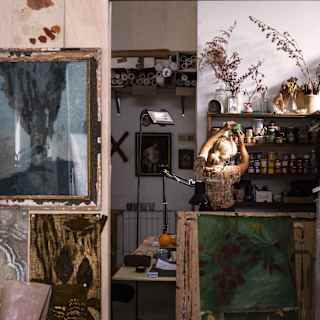
Italy’s ultimate retreat and Renaissance haven, Villa San Michele occupies a privileged perch on the hills overlooking Florence. Set within the original monastery and gardens, every space is designed to deepen the connection to Florence’s breathtaking landscape and rich culture. Discover the artisans reviving this Renaissance legend, now open after a complete renovation.
A building of historical significance – one that has stood the test of time, living and breathing through different functions and under various caretakers – not only captivates its viewers through the eyes but through the stories that echo around its walls. Evidence of the hands that have carved, sculpted, plastered and decorated its features unfold one by one, as the imagination quickly begins to fill the gaps of time.
For architect and designer Luigi Fragola, it was the stillness of Villa San Michele in the hills above Florence that first struck him as he walked through the 15th century estate. “What fascinated me was the silence – that silence of places that have truly lived,” he says. Based locally, Fragola is well versed in the deep craft roots of Tuscany and has spent the last two years working on the immaculate restoration of the hotel, drawing on local makers and specialists throughout the region to bring his vision to life.
Through the ornate façade of the Villa, attributed to the school of Michelangelo, layers of features added through the centuries remain on show, telling the stories of how these spaces were lived in as it was passed down to different owners. As a designer, working on such storied buildings is an exercise of limitation, where creativity is truly put to the test. “The greatest challenge was resisting the urge to add, to improve,” says Fragola. The reimagined rooms and suites take cues from Tuscan craftsmanship, together with the colours of the Renaissance terraced gardens, abundant with flora and fauna.
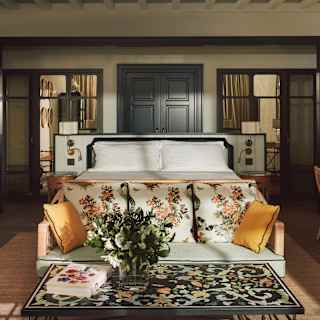
Within the interiors, rich Rubelli fabrics and colour-blocked upholstery sit alongside stripes in yellows and terracotta. The property will also feature a new spa, the Villa San Michele Spa by Guerlain – which will host a nature-immersive programme. Meanwhile, the new rooms and suites showcase numerous artisanal details, from marble bathrooms to hand-painted tapestries and scagliola tables – a local plastering technique from the 17th century. In these details, a new story unfolds.
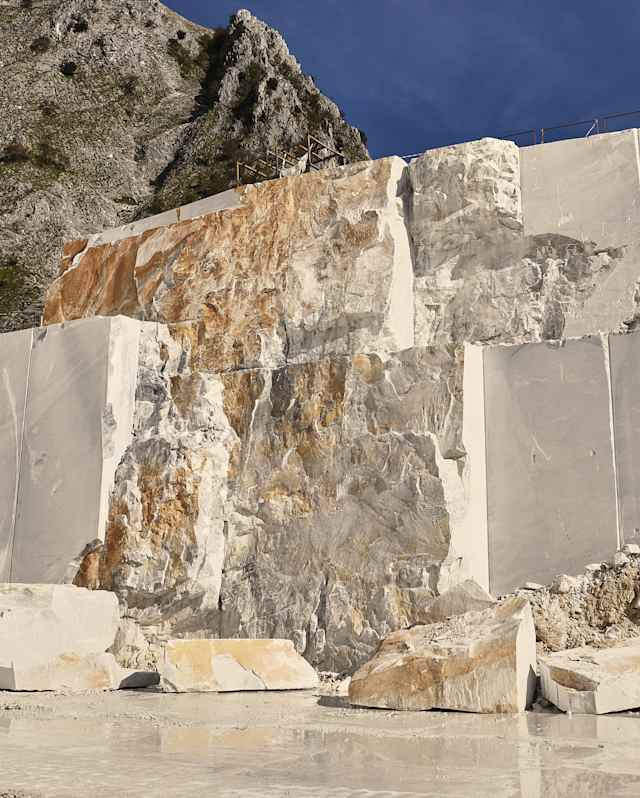
Marble from the Caves of Carrara
The Carrara caves in the Apuan Alps, about two hours north of Florence, have been the source of the world’s most coveted marble since the time of the Romans, who used this ‘white gold’ to make the likes of the Pantheon, Trajan’s Column and Michelangelo’s David. More recently, Barbara Hepworth and Isamu Noguchi’s large-scale sculptures in Carrara marble have demonstrated the versatility of the material.
A distinct upgrade since the monastic origins of Villa San Michele, the bathrooms of the newly designed rooms and suites feature generous splashings of marble, in which double vanities, floors, walk-in showers, window frames and wall panels are made from large slabs of Carrara alongside the increasingly rare, blue-veined Cipollino marble. Nonetheless, they remain simple in design to not detract from the mesmerising details of the stone and architectural features of the building. The active quarries and underground mines in the region also make an interesting day trip from the hotel to get a feel for its history and extraction process. These white mountains were first used by Julius Caesar around the 2nd Century BC, and they remain in the highest prestige among the leading designers and artists of today.
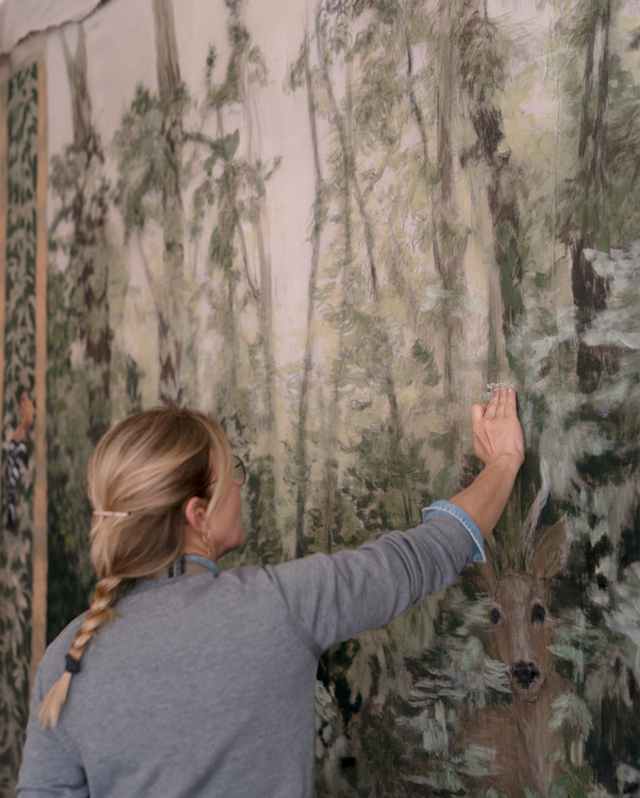
Art by Elena Carozzi
Coming from a creative family of antiquarians and painters, Elena Carozzi is an artist who creates a world of wonder within her hand-painted tapestries, wallcoverings and murals. Born in Milan, she spent prolonged periods at the studio of her grandfather, Gian Carozzi – who was a founder of the Spatial movement in the 1950s, together with Lucio Fontana – she was drawn to painting. Each of the works that hang in the newly restored spaces are experienced like a large-format painting, stopping you in your tracks to take in every vista and detail.
As with all her work, the tapestries reference scenes from nature, particularly that of Tuscan landscapes found around the estate. In the Villa’s new Guerlain spa, her hand-painted murals and frescoes set off the enchanting ‘secret garden’ entrance and reception area, while in bedrooms, her tapestries hang above beds like a window looking out onto the gardens. Carozzi’s painting style is influenced by studying ancient tapestries, and her pieces at Villa San Michele are complemented by large neoclassical textiles that are hung in living spaces amongst antique furniture and layers of fabrics on the upholstery, creating a lived-in country look.
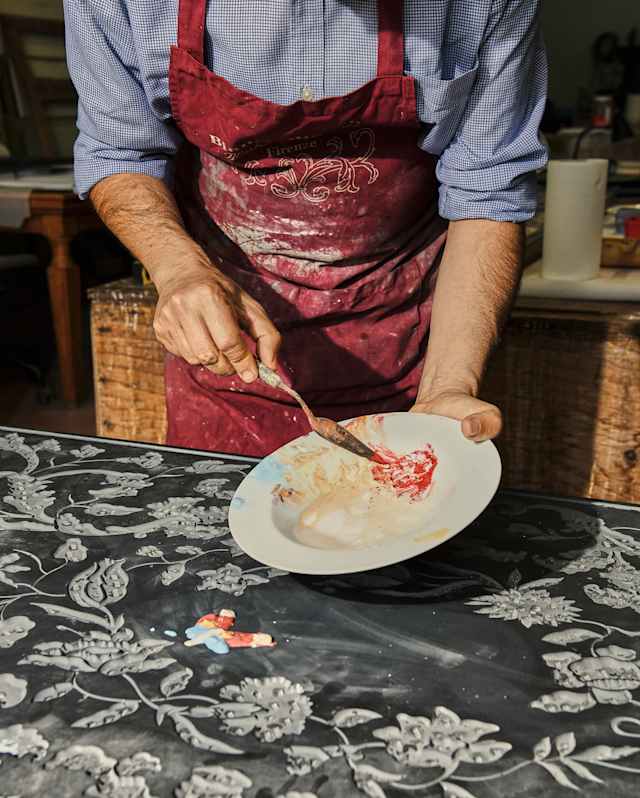
Scagliola by Bianco Bianchi
Preserving the centuries-old tradition of scagliola from its workshop in the Tuscan town of Pontassieve, Bianco Bianchi’s beautifully ornate works can be seen on handmade tabletops in the new suites of Villa San Michele, such as Botanica, which draws on the Villa’s tiered gardens. Having first opened shop in Florence in the 1950s, today Bianco Bianchi’s children, Alessandro and Elisabetta, and his grandson Leonardo, are at the helm. The familes continue to work with artisans and decorators to create heirlooms for private homes, hotels and museums, as well as collaborating across the world of fashion, art and design.
One noteworthy collaboration was with Gianni Versace in the 1980s, for which Bianchi created several pieces, including a Medusa-head table for the designer while he was searching for a logo for his fashion house. The making process behind each scagliola piece is an intricate concoction of handwork, which involves f irst drawing the sketch of the design and then transferring it onto a slab – be it marble, stone or scagliola itself, which is a mix of coloured pigments, natural resins and selenite powder. The design’s outline is then engraved and hollowed out, creating cavities into which the scagliola mixture is then applied.
Colours are added one by one, and details are finely engraved using a tool called a burin. The graffito is filled with scagliola and smoothed, and the surface is then polished before being treated with a satin protective coat. This meticulous craft has become recognised around the world – Bianchi himself was brought to the US to perform live workshops in the department stores of New York and Washington, and today their pieces remain in many museums. Like the finest artisans, they tell stories through a material language.
VILLA SAN MICHELE
A work of art inside and out with a history tracing back to the 15th century, Villa San Michele is a Renaissance villa in Florence that immerses you into the romance of Italy.
You might also enjoy
Fernanda Montenegro: A Star That Never Sets
As Copacabana Palace hotel renames its historic theater in honour of Fernanda Montenegro, Rafa Sales Ross looks back at the Grand Dame’s storied career to date.
The Maroma Playlist
André VII’s deep house-meet-dark-electro might, at first, sound like a world dominated solely by underground sounds. But dig a little and you’ll find that the DJ’s inspirations are plural, from radiant pop music to relaxing tunes – something evidenced in his Maroma playlist.
An Art & Design Lover’s Guide to Rio de Janeiro
From the tiled steps of Escadaria Selarón to hillside ateliers and bay-front museums, Rio de Janeiro is a city where modernism, music and tropical landscape collide. Discover Darcie Imbert’s guide to the artistic metropolis, featuring iconic works by Oscar Niemeyer and Roberto Burle Marx.

Holy Mountain
Mountains are an incredibly important symbol in Incan history and Andean culture — both geographically and culturally. Join us as we climb through the history of the Andean mountains, learning how indigenous people are maintaining ties to their natural and spiritual surroundings.
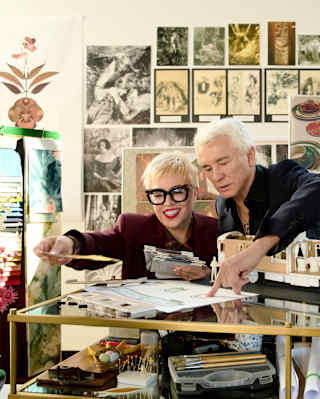
Celia, the British Pullman Carriage by Baz Luhrmann & Catherine Martin
Drawing inspiration from a broad sweep of theatrical history – from Shakespeare to Laurence Olivier – director Baz Luhrmann and cinematic designer Catherine Martin have created a dazzling new private dining carriage for the British Pullman. Here, we explore the story, process and craft behind the carriage Celia.
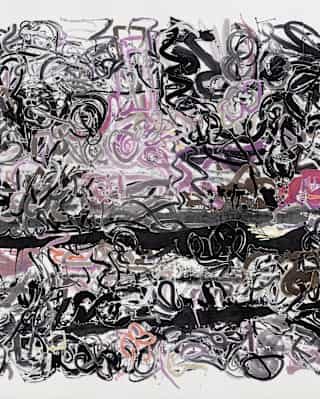
How 500 Brushstrokes Become One
“Human encounters are truly magical.” In an era shaped by artificial intelligence and rapid technological change, this reflection by Chinese artist Wu Jian’an feels quietly radical. It also serves as the emotional core of 500 Brushstrokes in Peru, his ambitious travelogue and participatory art project, soon to be exhibited at Art SG Singapore.
Belmond’s 2026 Culture Calendar
With our properties situated across some of the world’s most culturally rich destinations, our 2026 calendar highlights must-see music festivals, art fairs and luxury travel experiences around the globe.