An Art & Design Lover’s Guide to Rio de Janeiro

From the tiled steps of Escadaria Selarón to hillside ateliers and bay-front museums, Rio de Janeiro is a city where modernism, music and tropical landscape collide. Discover Darcie Imbert’s guide to the artistic metropolis, featuring iconic works by Oscar Niemeyer and Roberto Burle Marx.
The first clear impression of Rio comes from the air – on the descent into Santos Dumont – when the city begins to organise itself into deliberate shapes. From above, the coastline resolves into creatively engineered parkland, modernist housing complexes follow the contours of steep hills and civic buildings loom over dense central districts, revealing a city repeatedly reshaped in response to technical and social progress. Favelas appear as ingenious improvised pockets built into the hillside, the bright blue ocean is dotted with barely perceptible figures and Christ The Redeemer dominates the skyline. From the air, it’s obvious that Rio is a city full of life – defined by its ability to make space for living.
On the ground, everything becomes more sensory. Art, design and architecture in Rio is absorbed into daily life. The unmistakable geometry of Roberto Burle Marx’s waterfront paving has assimilated with boisterous beach life and concrete facades weather into a softer tonal palette at the mercy of sunshine and sea air. Music travels with ease through the busy city’s rugged topography, creating a constant soundtrack of samba mixed with a low mechanical hum.
What emerges is a city where art and design are rarely confined to white–walled institutions. It circulates through landscape, street culture, music, architecture and social spaces, producing a culture that is always living, breathing and growing.
Modernist Architecture in Rio de Janeiro
At the heart of Brazil’s modernist story is Edifício Gustavo Capanema, one of the city’s finest expressions of collaboration. Completed in the 1940s for the Ministry of Education and Health, it brought together Lucio Costa, Oscar Niemeyer early in his career, and Roberto Burle Marx, with advisory input from Le Corbusier. The building formalised a Brazilian interpretation of modernism – external shading systems that filter light and heat, pilotis lifting the structure from the ground, and a roof garden designed by Burle Marx that serves as a living, breathing canvas. Inside, large scale murals by Candido Portinari and his contemporaries occupy walls, drawing on social themes and reflecting the cultural politics of the early–mid 1940s.
From here, the surrounding streets show how Rio’s modernist ambitions took root across the city. Institutions like the Petrobras Headquarters belong to the era of industrial growth which brought new state buildings and towers in the centre of Rio.
The Metropolitan Cathedral of Saint Sebastian shifts the scale. Its vast, tapering concrete form rises abruptly above the surrounding streets, but the true spectacle reveals itself inside where vertical stained–glass panels extend upward, flooding the space with filtered colour. The building was designed by architect Edgar de Oliveira da Fonesca, who drew inspiration from the pyramidal forms of pre–Columbian architecture, all while working within the structural possibilities of concrete.

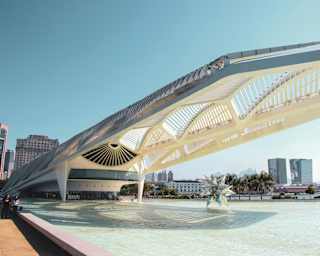
The Museum of Tomorrow, designed by Santiago Calatrava.
Best Museums & Art Institutions in Rio
Rio’s museums and galleries are as much about their settings as their collections. Some stretch out beside the bay, others occupy restored historical structures and many were designed to connect with the streets and landscape around them.
The Museu de Arte Moderna is a natural starting point. Designed by Affonso Eduardo Reidy and set within gardens shaped by Roberto Burle Marx with the support of Lota de Macedo Soares, the museum sits low beside the bay, its long concrete structure open to light, air and the surrounding park. The landscape is part of the experience, so the visit feels shaped as much by the setting as by the exhibitions.
At the Museum of Tomorrow, Santiago Calatrava’s elongated white structure stretches into Guanabara Bay, its movable solar panels and large shading wings forming a visible part of the design while reinforcing the museum’s focus on climate and scientific futures. The Museu de Arte do Rio pairs a restored historic palace with a contemporary exhibition building joined beneath a canopy, allowing it to move easily between art, photography and the layered social history of the city.
Beyond the larger institutions, Rio’s gallery scene spreads across several neighbourhoods, from the artist–run space A Gentil Carioca to Galeria Nara Roesler and venues such as Solar dos Abacaxis, Flexa, Virtual 3000, Galeria Refresco and Rato Gallery.

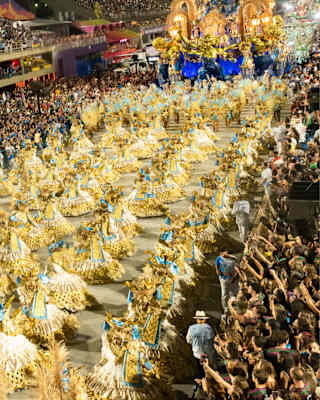
The Sambadrome Marquês de Sapucaí, designed by the architect Oscar Niemeyer.
Santa Teresa’s Modernist Homes & Art Scene
The hillside district of Santa Teresa offers one of the clearest views of how Brazilian modernism functioned as lived domestic architecture. Architect Wladimir Alves de Souza’s work is best encountered through Chez Georges, a residential structure turned guesthouse. The house demonstrates a defining Brazilian modernist principle: permeability between building and landscape rather than separation. It was once the home of the designer Ricardo Fasanello, and many of his sculptural pieces still fill the property today. As a private property, the best way to take a look around is by booking a day pass directly with Chez Georges.
Nearby, the Museu da Chácara do Céu preserves the former home of collector Raymundo Ottoni de Castro Maya, by the same architect. The building’s architectural clarity sits alongside a collection spanning Brazilian modernist painting and European works, displayed within landscaped gardens overlooking the city – framing a brilliant view of the aforementioned cathedral.
A short distance away, Bar do Mineiro delivers a laidback continuation of culture. The founder also happened to be the greatest collector of works by artists including Miriam Inez, Burle Marx, Alfredo Volpi, Guga Farraz, and many others – much of the collection now exists on the restaurant walls. Take a seat at one of the marble tables and indulge in generous portions of very honest, very delicious Brazilian fare.
Roberto Burle Marx & Rio’s Landscape Design
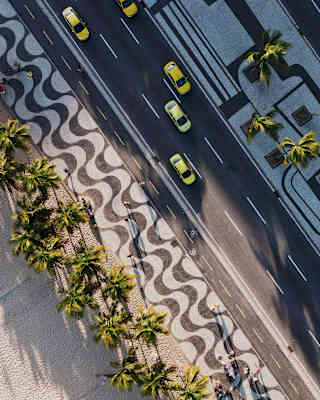
Roberto Burle Marx’s contribution to Rio extends far beyond individual gardens. His work rewrote the relationship between tropical ecology and modern urban design. The Copacabana promenade translates traditional Portuguese paving into an immense abstract composition, functioning simultaneously as pedestrian infrastructure and visual landmark. At the Aterro do Flamengo, his ambitions expanded to urban scale, transforming reclaimed coastline into an integrated system of parkland, transport routes and botanical planting focused on native species.

The mosaic promenade of Copacabana, desgined by landscape architect Roberto Burle Marx.
The Design World of Ricardo Fasanello
Ricardo Fasanello belongs to a later generation of Brazilian modernist designers, emerging in Rio during the late 1960s and reaching wider recognition in the 1970s, when experimental furniture design began to reflect the country’s industrial expansion and material innovation.
Working extensively with fibreglass and moulds – materials more often associated with automotive and aerospace production – he developed sculptural seating designed for comfort as well as visual impact. His best–known series explored modular forms and ergonomic curves, often produced in small runs rather than mass manufacture, which helped establish his reputation among architects, collectors and design enthusiasts in Brazil and beyond.
Based in Rio, Fasanello’s studio operated within the same cultural environment that shaped the country’s modernist architecture, showing how the same interest in new materials, structural experimentation and bold forms extended beyond public buildings into domestic interiors and collectible design. You can visit the Ricardo Fasanello atelier with an appointment made via their instagram.

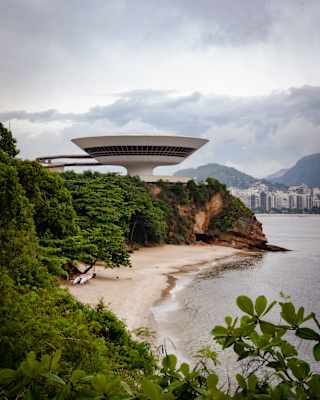
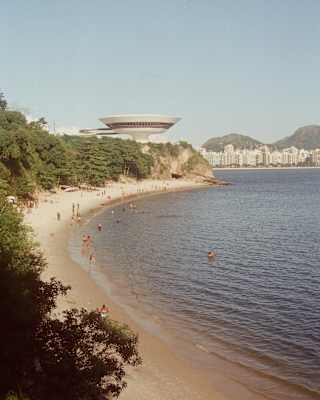
The Niterói Contemporary Art Museum, seen from Boa Viagem bay.
Oscar Niemeyer’s Most Iconic Buildings in Rio
Few architects shaped modern Brazil as profoundly as Oscar Niemeyer. Known for his use of reinforced concrete and sweeping, sculptural curves, he helped define a distinctly Brazilian form of modernism that combined engineering ambition with a strong sense of visual drama.
Nowhere is that language more palpable than at the Niterói Contemporary Art Museum, with its distinctive circular structure appearing to hover above Guanabara Bay. Reached by a long, red ramp, the building turns the approach into part of the experience, framing wide views back toward Rio and making the museum itself one of the country’s most iconic buildings.
Elsewhere in the region, Niemeyer’s Casa das Canoas shows how the same ideas could work at a domestic scale. The cylindrical Hotel Nacional reflects the era when Rio promoted itself as an international modern tourist destination, while the Obra do Berço nursery reveals his continued involvement in public education and social infrastructure. His participation in the prefabricated CIEP school programme, developed with educator Darcy Ribeiro, further reflects the belief that architecture could play an active role in shaping social life.
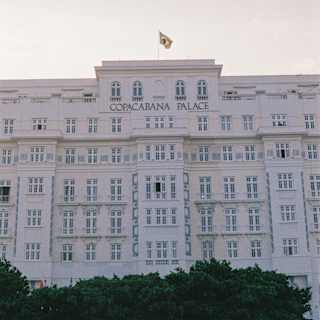
The Copacabana Palace is a landmark in itself, an architectural masterpiece incorporating neoclassical and art deco influences. Book your stay in Rio de Janeiro today.
An Art & Design Lover’s Guide to Mexico City
While Modernist icons like Frida Kahlo, Diego Rivera and Luis Barragán sowed the seeds of greatness, a new cohort of creatives are steering Mexico City’s cultural conversation into a contemporary space. Beyond the few days in February that make up art week and the well–trodden landmarks that feature in every other city guide, there is plenty more here that promises to reward the art and design lover that is willing to dig deeper.

Delve deeper into
You might also enjoy

Holy Mountain
Mountains are an incredibly important symbol in Incan history and Andean culture — both geographically and culturally. Join us as we climb through the history of the Andean mountains, learning how indigenous people are maintaining ties to their natural and spiritual surroundings.

Celia, the British Pullman Carriage by Baz Luhrmann & Catherine Martin
Drawing inspiration from a broad sweep of theatrical history – from Shakespeare to Laurence Olivier – director Baz Luhrmann and cinematic designer Catherine Martin have created a dazzling new private dining carriage for the British Pullman. Here, we explore the story, process and craft behind the carriage Celia.

How 500 Brushstrokes Become One
“Human encounters are truly magical.” In an era shaped by artificial intelligence and rapid technological change, this reflection by Chinese artist Wu Jian’an feels quietly radical. It also serves as the emotional core of 500 Brushstrokes in Peru, his ambitious travelogue and participatory art project, soon to be exhibited at Art SG Singapore.

The Artisans Reimagining Florence’s Finest Hotel
Italy’s ultimate retreat and Renaissance haven, Villa San Michele occupies a privileged perch on the hills overlooking Florence. Set within the original monastery and gardens, every space is designed to deepen the connection to Florence’s breathtaking landscape and rich culture. Discover the artisans reviving this Renaissance legend, reopening in Spring 2026 after a complete renovation.

Belmond’s 2026 Culture Calendar
With our properties situated across some of the world’s most culturally rich destinations, our 2026 calendar highlights must-see music festivals, art fairs and luxury travel experiences around the globe.

How Wes Anderson Redesigned Our Train
Travel in a vintage train carriage designed by pioneering film director Wes Anderson, director of new film The Phoenician's Scheme, on your next visit to the United Kingdom.

And The Winner Is…
The Belmond Photographic Residency, now in its second year, has crowned a new winner. Meet Tara L. C. Sood and her award-winning submission.