Fernanda Montenegro: A Star That Never Sets

Rafa Sales Ross
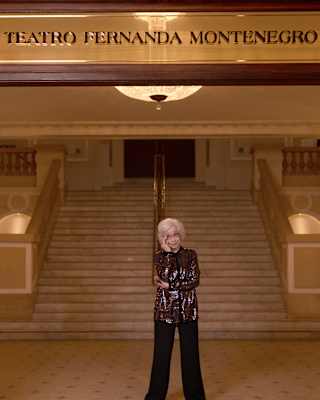
An elderly woman with white hair stands smiling in front of a grand staircase under a sign that reads Teatro Fernanda Montenegro. The elegant setting features ornate railings and warm lighting.

As Copacabana Palace hotel renames its historic theater in honour of Fernanda Montenegro, Rafa Sales Ross looks back at the Grand Dame’s storied career to date.

If someone were to wander a street in any Brazilian city, tap a stranger on the shoulder and ask them to name the most significant actress in their country, chances are you’d barely finish the question before hearing the words: Fernanda Montenegro. In a country often defined by contrasts and complexities, this 96-year-old Grand Dame of Brazilian theatre is one of the rare points of agreement – a towering figure who has carved out a dazzling career spanning eight decades.

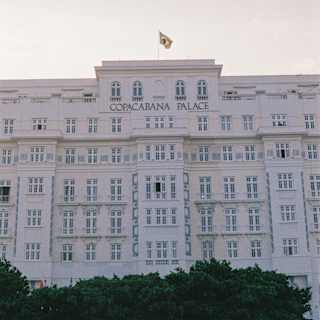
Born Arlette Pinheiro Esteves da Silva in 1929, Montenegro came into the world during a time of major political and economic unrest. It was also the moment when one of the country’s key cultural exports, Brazilian Modernism, was taking shape. It is beautifully fitting; Montenegro’s career, much like that movement, would go on to challenge boundaries and reshape what Brazilian art could be. Her birth also came just six years after the opening of Rio de Janeiro’s premier luxury hotel, Copacabana Palace, which has just renamed its historic theatre in honour of the Rio-born actress’ contribution to Brazilian stage and screen.  

Modernism in Brazil was all about taking outside influences and transforming them into something distinctly local – something that reflected the rich tapestry of the country’s identity. Montenegro would go on to do something very similar. In 1951, she became the first actress signed to Brazil’s first television network, TV Tupi, stepping into a brand-new medium and helping shape it into something unmistakably Brazilian. Television, still a novelty at the time, gave Montenegro a powerful new stage: people’s living rooms. She had already begun her theatre career at 20, debuting in 1950 at the prestigious Copacabana Theatre. But TV allowed her to bring that same dramatic intensity to a much wider audience. In just a few years at TV Tupi, she appeared in over 80 productions, an astonishing output that placed her right at the heart of a rapidly evolving industry. 

Even as television took off, theatre remained her anchor. In the decade to come, she amassed hundreds of credits and eventually founded her own theatre company, Companhia dos Sete, alongside husband and creative collaborator Fernando Torres. Her stage career alone would be enough to secure her legacy, spanning some of the biggest successes of Brazilian theatre, like Jorge Andrade’s A Moratória and Artur Azevedo’s O Mambembe, to unforgettable turns in adaptations such as Rainer Werner Fassbinder’s The Bitter Tears of Petra von Kant and seminal texts like Euripides’ Medea.  

It was that Latin American staple, the telenovela, that catapulted the actress to national stardom. She became the protagonist of TV Tupi’s telenovela, A Muralha, in 1954. Just over a decade later, she joined what would become Brazil’s largest and most influential TV channel, Globo, right at its inception. At Globo, Montenegro achieved unparalleled reach, her face becoming like that of a friend to millions of Brazilians who would spend a few hours with her every evening. Whether playing a sharp-tongued feminist in Guerra dos Sexos or a deliciously ruthless villain in Belíssima, Montenegro had that rare magnetism: if she was on screen, people watched.   

And she never settled into one mould. Beyond telenovelas, she explored more experimental television, helping bring to life richly textured stories rooted in Brazilian folklore and imagination. Productions like Hoje É Dia de Maria and A Dog’s Will struck a rare balance – beloved by audiences and critics alike – and continue to resonate across generations. In A Dog’s Will, Montenegro delivered one of her most iconic performances as Compadecida, a compassionate, humanised vision of the divine that audiences instantly connected with. Around the same time, she took on another role that would change everything: Dora, the complex, guarded schoolteacher at the heart of Central Station.

With Central Station, Montenegro earned Brazil’s first-ever Oscar acting nomination thanks to a gut-wrenching turn as Dora (losing out on the gong to Gwyneth Paltrow). The visibility of her Oscar nod boosted not only Brazilian cinema internationally but also consolidated Montenegro as a household name beyond her home country. Over two decades later, the actress would make Oscar history once again when she reunited with Salles for I’m Still Here. In a poetic twist, that film would not only become Brazil’s first ever to win an Oscar for Best International Film, but also earn a Best Actress nomination for Fernanda Torres, Montenegro’s daughter – a legacy, quite literally, passed on.

Yes, she has now been active for over eight decades, but do not dare bring up the idea of retiring to the trailblazing Montenegro. She shows no sign of stopping and refuses to label any performance – be it on stage or screen – as possibly her last. The legendary titan has just starred in Cláudio Torres’s action comedy Old Bandits (plotting a bank robbery, no less!) and is due to return to TV screens later in 2026 with Globoplay’s fast-paced procedural Emergency 53. In 2024, she even set a Guinness World Record, performing a Simone de Beauvoir reading to an audience of over 15,000 people in São Paulo. 

If there’s a thread running through her life and career, it’s this: a refusal to stop, to settle, to accept limits. Like the words of de Beauvoir she once recited to a massive crowd: “I am incapable of conceiving infinity, and yet I do not accept finity. I want this adventure that is the context of my life to go on without end.”

EXPLORE COPACABANA PALACE

Delve deeper into

You might also enjoy