Celia, the British Pullman Carriage by Baz Luhrmann & Catherine Martin

Drawing inspiration from a broad sweep of theatrical history – from Shakespeare to Laurence Olivier – director Baz Luhrmann and cinematic designer Catherine Martin have created a dazzling new private dining carriage for the British Pullman. Here, we explore the story, process and craft behind the carriage Celia.
You’re both seasoned storytellers; what’s the story you set out to tell here?
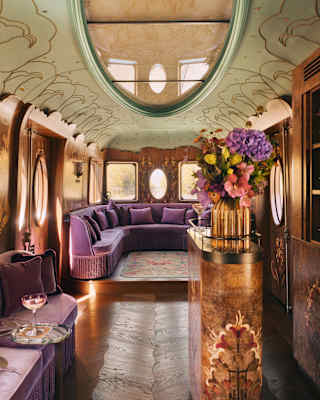
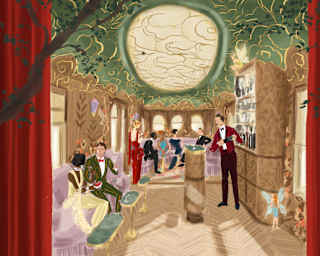
Baz Luhrmann: We wanted a story that allowed us to push creativity, luxury and uniqueness as far as they could go. Enter ‘Celia’, our fictitious West End icon of 1932, with a legendary mononym long before it was fashionable. Our narrative echoes the dynamic of Charles Foster Kane and Susan Alexander – of Citizen Kane – itself inspired by William Randolph Hearst and Marion Davies. Davies famously had the most glamorous and extravagant things built for her by Hearst, including a private beach bungalow. In our story, our American industrialist ‘John’, not unlike Hearst, has a beautiful private dining carriage crafted for his lover Celia and her glamorous friends. John becomes a metaphorical linchpin, marrying the pinnacle of rail innovation of the era – the Pullman cars – with the romance and exacting artistry of English craftsmanship. You feel this in the delicate inlays, the carved panelling, the polished fittings.
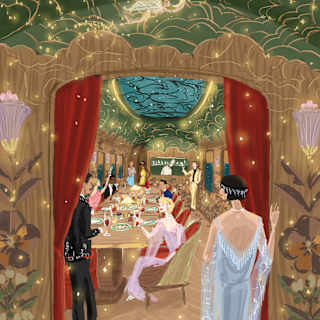
Guests step into this feat of machinery and experience a personalised love letter. After a Sunday matinee of ‘A Midsummer Night’s Dream’, Celia and her friends escape the crowds and steal away aboard this state-of-the-art train, pouring champagne, and laughing off the highs and lows of their latest show. From the moment someone receives an invitation, or chooses to board Celia, they should be drawn instantly into her world and be swept into the glamorous, mysterious life of the actress for whom the carriage was named.
How did your cinematic backgrounds impact your approach to this project?
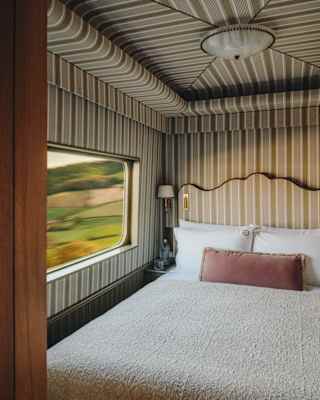
Catherine Martin: Once we had Baz’s character of Celia, the interior design of the carriage became a space encoded with her life story, a world carefully constructed so that the passenger might step inside it and be transported into her universe. Watching the world slip past through a rectangular window that frames the landscape is actually a profoundly filmic experience. Like a film, the timeframe is fixed, and the designer’s role is to guide the participant’s perspective within the constraints of a relatively small space. Film, theatre, and storytelling through design are all exercises in solving practical problems, without allowing them to obstruct the imagination. In the same way, the limitations of a train carriage should never dictate the experience – they should inspire it. Designing the interior of a train is fundamentally about how humans inhabit space; that is both the challenge and the thrill.
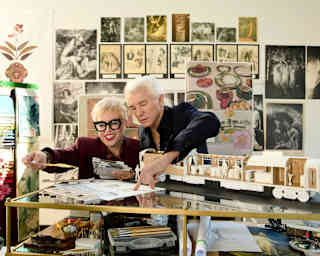
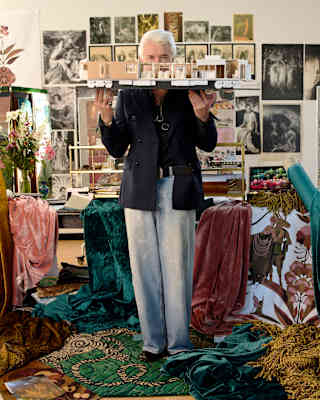
BL: I always begin with the philosophy of what we're trying to convey to an audience, in this case, a traveller. Once the philosophy is set, then comes the narrative, the story, the writing of the script and the creating the characters. At any moment, we're able to draw on this foundation, just like we would in a movie, and be guided as to what the visual language choices are. It’s a complete collaboration between Catherine and me to shape the visual language, which includes everything from a plate to the inlay. Our North Star is always the story and the characters, and so it is in cinema, too.
What appealed to you about trains, and slow travel in general?
BL: We’re both devoted lovers of slow travel as there’s an undeniable magic and romance to these kinds of journeys. It’s a form of travel that lends itself to being told in the most evocative and cinematic ways. I’ve found that any slow journey, particularly on trains and boats, truly inspires my inner creative soul from the moment I step on board. The wheels in my ‘imaginator’ – a phrase my young son referred to when talking about the imagination – start to turn, just as the wheels on a train do, in moving us forward through the landscape. I love it.
CM: Modern life moves at an extraordinary pace; rarely do we fully experience one moment before rushing toward the next. Slow travel offers the ultimate luxury – the time and space to truly connect with the journey itself. It allows the mind to decelerate, opening the possibility of deeper connection not only to oneself and to others, but also to new cultures, new perspectives, and different ways of seeing the world.


How do you envision people using this space?
BL: The possibilities for Celia are endless. It’s the perfect, almost dream-like setting for a group of friends who want to drink, dine and dance in an experience unlike any other. With the simple closing of a curtain, the car transforms into a performance space: a place where a father might speak at a beloved child’s birthday or engagement, or, when the occasion calls for a bit more fun, somewhere music can be spun. In that way, Celia also echoes the philosophy of a film set; a space designed with intention to adapt and heighten whatever the traveller’s unique story requires. It works beautifully as a creative retreat, or in a business setting, it becomes an intimate environment for discussion, a product launch, or a special announcement.
Celia also has the capacity to transform into a performance space; I have no doubt a musical artist could have great fun staging an unplugged session or making an album announcement there. And of course, we’ll be fitting out the carriage with a terrific sound system and speakers to support that. Ultimately, Celia is a catalyst, a place that brings people together and invites them to get lost, not only in the physical journey, but in the romantic, hidden magic of the space itself. By the end, our travellers step out having experienced something singular and unforgettable.
CM: My experience of Pullman train travel was defined by the joy of doing something unexpected and glamorous. It felt like stepping into a time machine – an opportunity to inhabit the luxury and nostalgia of another era. I imagine people eating and dancing, arguing and falling in love, taking photographs, celebrating life’s great moments and adventures – all within a world that offers a pause from the chaos of everyday life. A moment of respite. A moment of celebration. A small, luminous bubble of light and love.
Pullman is a uniquely British experience in some ways – is this something you consciously set out to explore?
BL: Yes, absolutely. From the very beginning, we wanted to tell a distinctly English story. Though Celia and her lover are fictitious, she and her circle are inspired by very real people. Another great inspiration was Sir Laurence Olivier, who would often take a Pullman train home after nights at the theatre. This was a starting point for the romance and the world we wanted to evoke.
Also, it doesn’t get much more quintessentially English than Shakespeare! Shakespeare is so deeply woven into the British identity and cultural psyche that the intoxicating, effervescent, dream-soaked world of ‘A Midsummer Night’s Dream’ became the perfect setting for our characters. It’s been a rich expression of British imagination, comedy and mischief, much like the spirited adventures Celia and her companions find themselves swept up in aboard the carriage.
Finally, how would you sum up Celia in a sentence?
BL: The playful way to put it is that it’s the world’s most elegant, extraordinary, once-in-a-lifetime private party bus, haha!
But truly, it’s a magical mystery tour; a travelling dining experience with friends, filled with food, music, wine, laughter and performance, all unfolding while you drift through the countryside, as if you’ve stepped inside ‘A Midsummer Night’s Dream’.
The Celia carriage is now available for exclusive group bookings on the British Pullman.
Celia
Baz Luhrmann and Catherine Martin bring their inimitable cinematic storytelling to the British Pullman, Britain’s most iconic train. Meet Celia, the inspiration behind the new extraordinary venue on the rails, where personalised features and bespoke experiences await.
Find out more about the Celia carriage, and hire the private venue for your ultimate celebrations, hosting up to 12 guests.

Delve deeper into
You might also enjoy

How 500 Brushstrokes Become One
“Human encounters are truly magical.” In an era shaped by artificial intelligence and rapid technological change, this reflection by Chinese artist Wu Jian’an feels quietly radical. It also serves as the emotional core of 500 Brushstrokes in Peru, his ambitious travelogue and participatory art project, soon to be exhibited at Art SG Singapore.

The Artisans Reimagining Florence’s Finest Hotel
Italy’s ultimate retreat and Renaissance haven, Villa San Michele occupies a privileged perch on the hills overlooking Florence. Set within the original monastery and gardens, every space is designed to deepen the connection to Florence’s breathtaking landscape and rich culture. Discover the artisans reviving this Renaissance legend, reopening in Spring 2026 after a complete renovation.

Belmond’s 2026 Culture Calendar
With our properties situated across some of the world’s most culturally rich destinations, our 2026 calendar highlights must-see music festivals, art fairs and luxury travel experiences around the globe.

How Wes Anderson Redesigned Our Train
Travel in a vintage train carriage designed by pioneering film director Wes Anderson, director of new film The Phoenician's Scheme, on your next visit to the United Kingdom.

And The Winner Is…
The Belmond Photographic Residency, now in its second year, has crowned a new winner. Meet Tara L. C. Sood and her award-winning submission.

Eat Your Way Through El Bajío
Discover ‘El Bajío: Recipes & Wanderings Through Mexico’s Heartland,’ the fourth cookbook in the collaborative series between Belmond and Apartamento.

JR on the Making of L’Observatoire
The renowned French artist JR challenges traditions and sparks dialogue with his monumental artistic creations. Turning his eye to the iconic Venice Simplon-Orient-Express where he's designed an entire carriage onboard, the L’Observatoire is an artwork in motion. Transforming every detail into an opportunity for introspection and adventure, read JR in his own words as he explores the deeper meaning behind his most ambitious project yet.