Swinging Sardinia
Swinging Sardinia

As Romazzino re-opens its doors in Porto Cervo, Christina Newland traces the Costa Smeralda’s glamorous history – from the Swinging Sixties to the glittering present.
If you had to capture the spirit of Sardinia’s retro seaside chic in a song, there’s one that readily comes to mind. Folk songwriter Peter Sarstedt’s lissome ode to sixties socialite glamour, ‘Where Do You Go To (My Lovely)’, with its mention of Balmain and suntans and bohemian larks, name-checks a key figure in the pop history of Mediterranean glamour: the Aga Khan.
‘Your name is heard in high places/You know the Aga Khan/He sent you a racehorse for Christmas/And you keep it just for fun’, goes the song. Aga Khan IV – a member of Iranian royalty and current Imam of Nizari Isma'ilis – has long known a thing or two about wealth and glamour. His father, Aly Khan, was briefly married to Rita Hayworth; and he, on the cusp of the 1960s, was the person who first conceived of a modernist hotel getaway on Sardinia’s Costa Smeralda, known as Romazzino .
The young royal first heard of the location when a British banker he knew had gone sailing around Sardinia and had returned to London to regale his friends with tales of the unspoilt and gorgeous region. Inspired to visit, the Aga Khan fell hard for this strip of Sardinian coast. In 1962, with business partners which included Patrick Guinness, heir to the Guinness brewing fortune, he went about purchasing a 35-mile large tract of land to build villas there. Initially, he conceived of it as a private resort and yacht club for the international jet set, and the area, dubbed Porto Cervo, soon filled up. But the Aga Khan was a responsible developer and hotelier. When he decided to embark upon the construction of this luxury hotel, he did so with the region’s biodiversity and natural rhythms in mind, wanting to be harmonious with the Sardinian landscape.

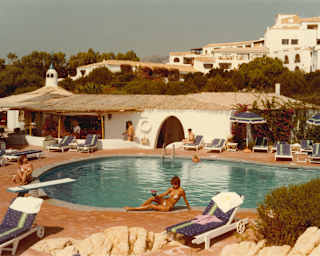
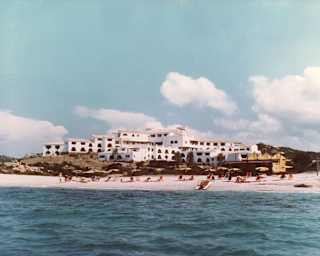
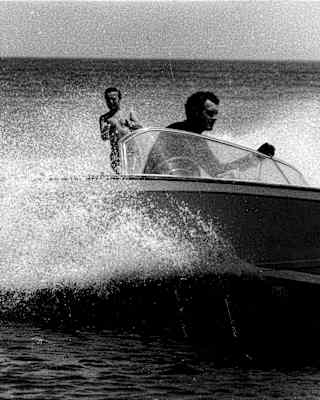
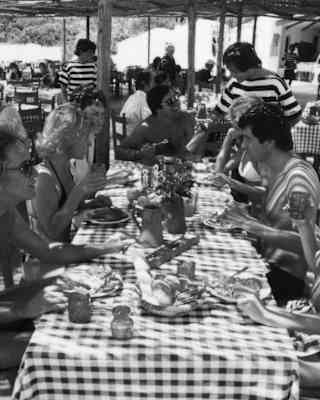
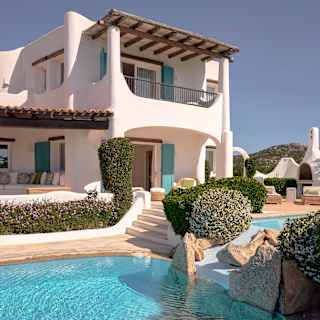
We owe Romazzino’s conception to Italian architect Michele Busiri Vici, who with his son Giancarlo, signed a jewel of a resort blending with its natural surroundings and sea views. With a similar organic principle to architect Antoni Gaudí, the stark white concrete of the hotel seems both apiece with the rocky terrain and stands astride it like a curving, shining bauble. Providing a Sicilian-Sardinian cuisine direct from nearby farms, suckling pig and roasted lamb were popular dishes for 1960s patrons there. Water skiing, skin-diving, and boating were most popular according to a 1969 LIFE Magazine photo story about the area, and the likes of Liz and Dick (Elizabeth Taylor and Richard Burton, of course) were known for pulling their yachts into the harbour.
Speaking of the harbour: the 2.5km white-sand beauty nearby, known as Spiaggia del Principe, was rumoured to be the favourite of the Aga Khan himself; but the Costa Smeralda (translation: emerald coast) is full of rocky half-moon bays on perfect pools of emerald blue-green Mediterranean Sea. Both a sea-salt-flecked relaxation point and a location to see and be seen, the Romazzino was a crown jewel in Italian holiday resorts, away from the frenzy of the Italian Riviera or the starry island of Capri. Conceived by royalty and designed to please them, it’s no surprise that the five star hotel harboured the likes of Grace Kelly and Princess Margaret, but this was no prim, fussy locale: Romazzino had a bohemian edge, also welcoming Ringo Starr, who was rumoured to have written his song “Octopus’s Garden” in Sardinia, fellow Beatle George Harrison with Pattie Boyd, his fashion plate wife at the time, as well as raucous comedian Peter Sellers.
Fittingly, in turn, the Romazzino attracted photographers and filmmakers who sought to capture its glory onscreen. Slim Aarons, legendary photographer and socialite anthropologist of sorts, described his modus as capturing “attractive people who were doing attractive things in attractive places.” There was hardly a better place to do so than Costa Smeralda, and Aarons captured stunning shots of assorted sunbathers and glass-like seas in the late sixties. So too did Vogue photographer Henry Clarke, capturing the lithe, sun-browned limbs of model and actor Marisa Berenson sprawled on the Sardinian rocks, often in tiny Pucci mini-dresses and sweeping patterned caftans that look just as wearable in 2024.
In 1970, Italian arthouse director Alberto Sordi would direct a segment of anthology film The Couples at Romazzino, capturing a romantic anniversary dinner gone comically awry. And a few years later, in 1977, the resort would perhaps get its permanent cultural rubber-stamp as a key, glittering destination: scenes from 007 flick The Spy Who Loved Me were shot there, with Roger Moore’s James Bond doing a bit of diving and underwater combat before emerging at the beach – and the resort – of Costa Smeralda.
Now reopening as a Belmond luxury hotel, the Romazzino of today will follow the same glorious emerald coastline that James Bond – and more to the point, the Aga Khan – discovered decades ago. For this storied and glamorous old beauty to reopen its doors this spring is to hear the echoes of previous guests: rock stars and long-haired, kohl-eyed muses, dissolute heiresses and gambling princes. You can imagine Elizabeth Taylor swanning through the lobby in a bell-sleeve dress, or Greta Garbo – yes, even she came to Romazzino – pulling her straps down to check her tan lines. While the world may have moved on from the thrill and hedonism of the sixties, this corner of Northeastern Sardinia may have figured out just how to update it for a modern visitor.
Delve deeper into
You might also enjoy

And The Winner Is…
The Belmond Photographic Residency, now in its second year, has crowned a new winner. Meet Tara L. C. Sood and her award-winning submission.

Eat Your Way Through El Bajío
Discover ‘El Bajío: Recipes & Wanderings Through Mexico’s Heartland,’ the fourth cookbook in the collaborative series between Belmond and Apartamento.

JR on the Making of L’Observatoire
The renowned French artist JR challenges traditions and sparks dialogue with his monumental artistic creations. Turning his eye to the iconic Venice Simplon-Orient-Express where he's designed an entire carriage onboard, the L’Observatoire is an artwork in motion. Transforming every detail into an opportunity for introspection and adventure, read JR in his own words as he explores the deeper meaning behind his most ambitious project yet.

How Wes Anderson Redesigned Our Train
Travel in a vintage train carriage designed by pioneering film director Wes Anderson, director of new film The Phoenician's Scheme, on your next visit to the United Kingdom.

Castello di Casole, As Seen by Cecy Young
The latest in Belmond’s ‘As Seen By’ photography series sees Cecy Young discover a sense of home in the sprawling hills of the Tuscan countryside.

Discover Belmond’s Photobooks
Inspired by Belmond’s one-of-a-kind hotels and destinations, ‘As Seen By’ is an collection of collectible photobooks with Parisian publisher RVB.

Luchino Visconti’s Tuscany
In the 1960s, Castello di Casole in Tuscany was a playground for one of the Italian film industry’s biggest disruptors. Film writer and historian Christina Newland, programmer of ‘Luchino Visconti: Decadence & Decay’ at the British Film Institute, explores the story of the Visconti brothers – their legendary parties, the glittering guestlists and the bar that honours them today.