We sat down with the prolific polymath to hear about the care and craft behind his suite design, as well as his vision for a new cultural institute to sit alongside it.
From Fashion to Interiors: Thebe Magugu’s Design Philosophy
You made your name in fashion, and this project represents your first major move into interiors. How did you find that transition?
Strangely enough, I didn't struggle at all. The narrative of a project has always been my starting point – the medium is kind of secondary to that core story. My name actually translates into English as something like ‘he who protects our treasures’, and when I started my label, this idea of celebrating the history of my people was central to my vision. I wanted to immortalise stories through the power of cloth! When I came into this project which was more focused on interiors, I wanted to extend this idea of using the suite as a real trove for our treasures. That may be through using certain materials, or certain fabrications, or curating artworks – it takes many forms – but really, it’s all about celebrating a three-dimensional experience of South African culture and heritage.
Afro-Modernity and Afro-English Influences at Mount Nelson
So, you’re always designing within a much bigger context, but was there a specific starting point for the story that you were wanting to explore here?
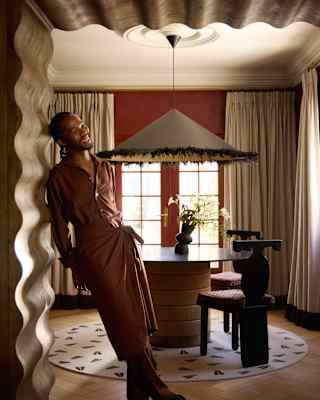
There were actually two main storylines in this project, which were interchangeable in some ways: one was the concept of ‘Afro-English’ and the other was ‘Afro-Modernity’. I'm obsessed with unusual juxtapositions – I think they create interesting tensions and provide a platform for telling new stories. If you look at the role that South African fashion and music and culture is playing on a world stage right now, a lot of this success comes down to bold new propositions for the future. So with the idea of ‘Afro-English’, I was looking at traditional English design motifs, such as wallpapers and print patterns, but then transforming them with an African sensibility. The suite is a very opulent space in one of the continent’s grandest hotels, and I wanted to bring in African details that have never been seen here before. For example, above the dining table there’s a striking light fixture, and that was inspired by the straw hats that are traditional to my Sotho culture. Or if you look at the carpet, you can see a footprint motif from the rhebok antelope, which has a great importance in Lesotho, where my family is also from. There are so many of these small details waiting to be discovered.
Materials, Craft and the Language of Care
And what about the materials and craft techniques that you’re using, do they help deepen this story too?
If you look at the tactility of the space, you'll see that there's a lot of folds and pleating, whether that’s in the way we’ve fabricated the lamps or the specific tucks in the suede on the couch. Even if you look at the wallpaper, there’s a texture that gives a sense of pleat or groove to it. I’m obsessed with pleats actually – it comes from the outfits that my grandmother would wear for church on Sundays, which were so regal and formal but also kind of free flowing. It’s where fluidity meets precision. Another materiality that tells a strong story is the Venetian plaster in the suite, because I really wanted the space to feel touched by a human hand. To feel hand polished, even in the slight imperfections. This reminds me of the burnish on traditional African huts, but also of my childhood, when I had to apply polish to the stoop at home every Sunday.
It feels like what you’re describing is showing care through materials as well – just like your grandmother showed care in her dress or you showed care in polishing the stoop. There’s a kind of thoughtful care for materials here.
Absolutely, that's a beautiful way to put it. Everything in the space is something that I care about. All the pieces are chosen to perfectly straddle form and function, so they may look very ornate but actually they’re incredibly robust, and I think this is another important part of the DNA of my brand. I don't want special clothes to make you feel like you're in this sort of gilded cage. I want you to feel beautiful, of course, but also for you to be able to enjoy your day-to-day. That’s the same feeling I want to invoke with my interiors.
Contemporary African Art in the Magugu Suite
There’s a lot of artwork in the suite as well, how did you go around the curation here?
This was all about championing contemporary African artists who I admire. The big cubist painting in the hallway as you enter is by an artist called Mmangaliso Nzuza, and I’m really obsessed with his work. European Cubism was heavily inspired by African art and imagery – you see a lot of African masks in these works – but Nzuza’s work is the first time I’ve seen this come back through an African lens. Other artists in the space include Lulama Wolf, Banele Khoza And Zandile Tsabalala, so it gives a really interesting cross-section of South African art.
Designing a Space for Retreat and Reflection
You mentioned how you wanted people to feel when wearing your designs, can you say a bit more about how do you want people to feel in the space?
I want people to feel like they can retreat into to themselves, for it to feel like a meditative space. The outside world can feel so tumultuous at times, so noisy and distraction filled, so I think there’s a real value to a space that allows you to retreat and switch all that off. I really want all the spaces that I design to feel like a sort of refuge for people, places that really give them time for themselves. That’s the most valuable thing that we as designers can give people. I think it’s a space to be free and be yourself – just to give you time and space to contemplate. Which I think brings us back to that concept of care, because when you know a place has been designed with care, then you feel held by that space in some way. There’s so much about the modern world that is about shortcuts and timesaving, so I think it’s also so important to create spaces slowly and with deep thought.
Magugu House: A New Cultural Institute in Cape Town
The Suite is one part of your project at Mount Nelson, but you’re also opening Magugu House here – the first space of its kind after Johannesburg – can you say about more about the concept?
It’s interesting how Magugu House has grown quite separately to the Thebe Magugu luxury brand, and when I started it, the sole idea was to create a space for the creative community in South Africa to come together and collaborate. So the Thebe Magugu brand is very much about my voice, but Magugu House was always about multiple voices. It’s a true community space meets cultural institute and has its own programming – whether that’s exhibitions or screenings or panel discussions. For a luxury hotel such as the Mount Nelson to host a space such as Magugu House is an incredibly strong statement about what role hospitality brands can play in their communities today.
It’s a very inspiring vision and thank you for sharing it. Finally, what are you most excited about for the future of this project?
I’m most excited to bring some authentic contemporary African culture into the hotel, so guests can really feel the vibrancy of what is happening here. We’ll have exhibitions at Magugu House, and events, and the opportunity to really meet with the creative community and connect in new ways. I can’t wait to see these spaces start to be lived in and see how people respond to them.