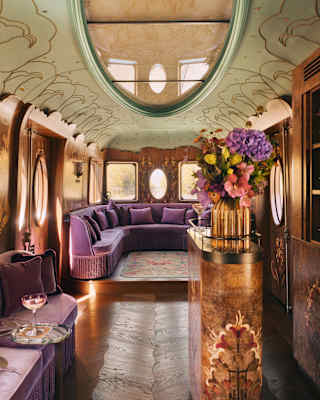
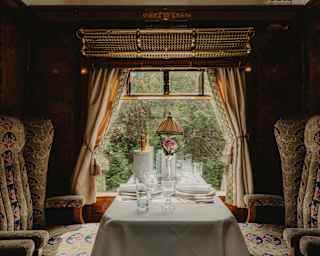
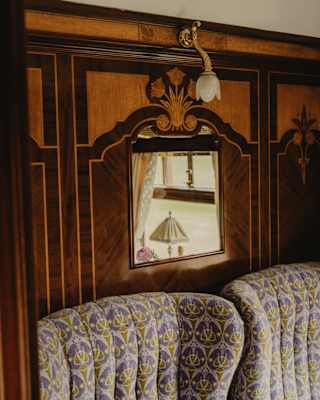
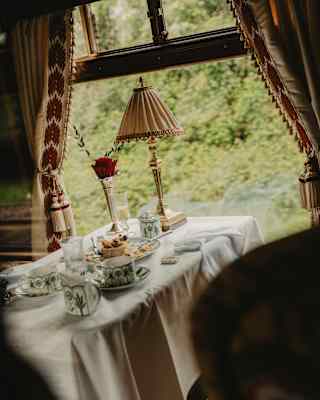
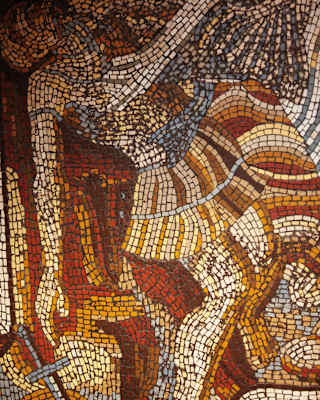
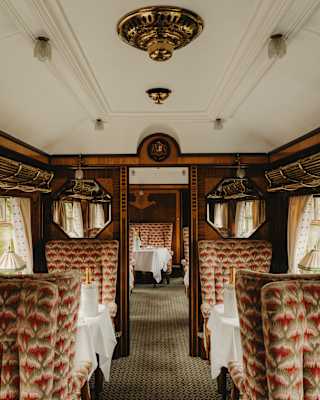
One of the most immediately striking features of British Pullman is the marquetry panelling. Each specially-named carriage boasts unique designs. In Vera your eye is drawn to an antelope springing between palms. Ibis is embellished by images of Greek dancing girls. Such ornate woodwork is a rarity in the modern world, and for this we owe a great debt to the Dunn family.
Albert Dunn established his studio, A Dunn & Son, in 1895. Having designed panelling for world famous ocean liners including the Titanic, the Lusitania, the Queen Mary and the Queen Elizabeth, he turned his talents towards British Pullman. Fortunately for us, A Dunn & Son remains a family-run operation. Today, it’s under the stewardship of Albert’s great-granddaughter Cheryl. Their machines are over 125 years old and the firm employs traditional methods dating back to the 1700s. We could not have restored our panelling so faithfully without their enduring commitment to artistry.
Such elaborate marquetry should be kept in resplendent condition. Alfred Greenham was one of the first British artisans to embrace the process of French polishing. His firm, A Grenham & Son, was established in 1884. The company’s work at Mansion House and 6 Cheyne Walk are some of the earliest English examples of the technique. Five generations later, the business remains in the family. Bryan Greenham visits us each year, meticulously working his way through the train. Each inch of wood panelling receives the finest French Polish – Bryan makes sure that our woodwork shines.