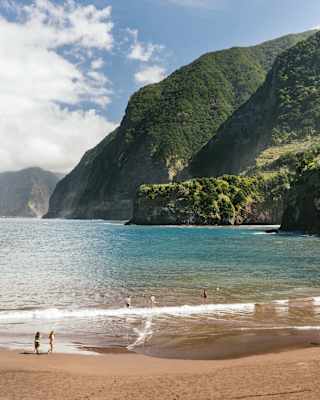
Brushing my hand over a vertical rockface of moss, lichen and ferns, water oozing out to join the levada flowing below, I wonder if the person who came up with the idea of architectural living walls of plants had ever visited the island. On my latest visit, in early winter, I’m taken by a guide to a route less trodden – Levada do Moinho – following the narrow pathway above a precipitous drop, nervously watching my footsteps one by one, until it leads us through a green-furred grotto and behind two waterfalls, jetting down to the pool below.
Trickle down, trickle down. “There are water thieves around, you know,” market gardener Sofia Freitas tells me, as she squints into the November sunlight. Freitas manages the land in Quinta da Palmeira, growing produce for José Diogo Costa, the executive creative chef at Reid’s Palace, A Belmond Hotel, Madeira, along with a few other restaurants on the island. “We’re allowed 12 hours of levada water a week,” she explains. “You lift the shutter at a certain time so we can irrigate the crops. It’s a system that works well, but there are always some people who take advantage...” She shows me around, swishing through high grass to uncover strawberries and Brazilian horseradish growing beneath. “We have a lot of weeds – nature doesn’t have bare soil, does it? The first rule here is: don’t be afraid to stand on things,” she laughs. She describes how herbs are fermented, “which we add to the water so she has more nutrients”. So water’s female? I ask, half-jokingly. “Of course,” comes the matter-of-fact reply, “she brings life.”
The volcanic soil of Madeira is almost indecently fertile. Things grow quickly here. At Quinta da Palmeira, that means pumpkins, broccoli and tomatoes, aubergines and fennel. Walk around the market and you’ll see some of the sheer diversity: the strange pineapple-banana, whose crocodile skin crumbles off when it’s ripe; passion fruit in pool-table colours; tomato-like tamarillo. Chef Costa holds a handful of bright red Surinam cherries and tells me they’re a favourite on his menu at William Restaurant in Reid’s Palace. There he digs deep into the island’s food traditions, using sugarcane and berries in sweet and savoury dishes, as well as smoked bay leaf, dried tuna and fennel. All around Funchal, water channels help irrigate Edwardian gardens such as the one at Reid’s Palace, planted more than a century ago when Madeira’s climate made it a laboratory for plant collectors – Mexican cacti here, a South African bird of paradise there, the spires of red aloe and yellow flowers of the popcorn plant below the tall trunks of cedars and Canary Island date palms.