História

A Taste of Mexico's Heartland

Autor(a)

Alonso Ruvalcaba

Photography

Heather Sten

5 min read

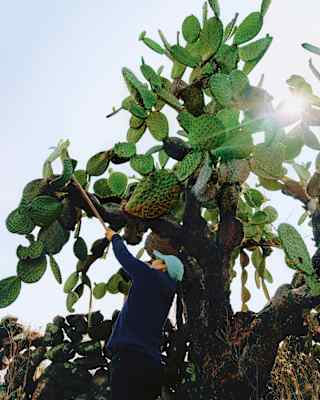
A person in a dark shirt stands under a large prickly pear cactus, reaching up to touch its pads. Sunlight shines through the top right of the cactus, creating a bright, backlit scene.

Our commitment to local terroir and culinary traditions runs deep, a fact that is celebrated in our ongoing cookbook series with Apartamento. Here’s a taster from our recent cookbook on Mexico’s central region of El Bajío.

The road into El Bajío never repeats itself. You might be driving up from Mexico City, watching the sprawl fall away as the air dries, and the hills gather into long, folding lines. Or you land in León, blinking into the white light of midday, and suddenly the scent of leather, guava, diesel and tortillas tells you you’ve arrived. Though, in truth, you were probably already there – awareness of arrival in El Bajío tends to happen after the fact, like getting the joke just as the room has gone quiet again. El Bajío is hard to pin down. Geographers say it’s a basin – ‘el bajío’, the lowlands between mountain ranges. What holds El Bajío together isn’t a map, it’s probably a tone. A temperament.  

Here, recipes survive not because they are treasured sentimentally, but because they work. Nobody has radically reinvented them because no one feels any great need. Innovation, when it appears, is quiet and sly. A garnish here. A misdirection there. Esquites, a delicious side of roasted corn usually served in a simple cup and eaten casually, is dressed up with rich bone marrow. There is a wealth of shifting salsas with endless permutations and more chillies to try than you can count. In fondas, ranch kitchens and small-town bakeries, people might even innovate without realising it. A mole made once a year is, inevitably, different every time. Pan ranchero is shaped without scales or clocks. Some dishes are adapted not for the sake of ‘reinterpretation’, but because the market ran out of lard that morning. 

Sometimes, the only recipe is proximity. A woman stirs a pot because someone’s coming. A man adds more chilli than usual because the day feels dull. A boy forgets the name of an herb but recognises it by smell. These kitchens don’t invent; they adjust. Not for applause, not for publication, just for the sake of feeding someone properly. And if the dish is good – good in that silent, complete way – you don’t say so. You just take another tortilla and reach for more. That, here, is how food says thank you: by allowing you to keep eating. Here, necessity is the mother of invention – and the great aunt of culinary improvisation. 
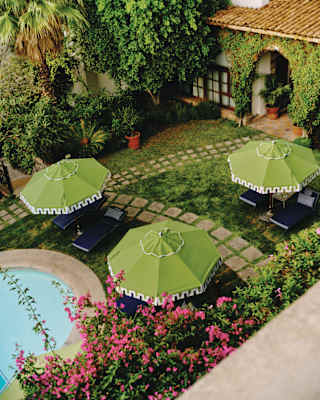
A courtyard garden with green parasols, lounge chairs, a small pool, stone pathways, and lush plants surrounding a building with a tiled roof and arched windows.
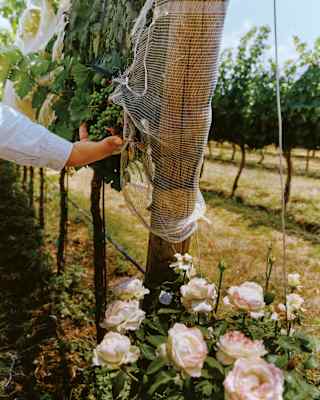
A person adjusts netting on a vineyard post among grapevines, with flowering pink roses growing at the base in sunlight.

Still, the new generation is speaking. Chefs like Fernanda Covarrubias don’t simply claim El Bajío as their stage, but the region’s gravity is in their work – its restraint, its precision, its quiet playfulness. They treat tradition not as a cage, but as a vocabulary. They know what Wilde knew: If you’re going to break a rule, it helps to have first embroidered it lovingly on silk.  

El Bajío doesn’t sell itself. Its cities don’t perform tradition as loudly as places like Mexico City, with its capital energy, or the various destinations along the Yucatán Peninsula. El Bajío lives its traditions. Tourists come for the colonial façades, the vineyards, the weddings. The region, with classic indifference, carries on. It has no interest in becoming the Next Big Thing. It’s already something else: consistent. Which, in an age addicted to novelty, is practically avant-garde.  

El Bajío doesn’t explain itself; to eat here is to be reminded of the shifting geometry of a well-made dish. Here, flavours take their time – quietly but with purpose, like someone late for mass but determined to arrive. It’s better to make your salsa for enchiladas del portal one day in advance to let all the flavours marry; take your time. Here is a heat that builds, not shocks. A kind of spiritual calibration, bite by bite. Look at that lady – she won’t smile until you’ve finished your plate. Or that man: He’s going to answer your question with a refrán, an albur, or a proverb. If you keep asking, he’ll answer with a shrug. He’ll be here long after you and I are gone. 

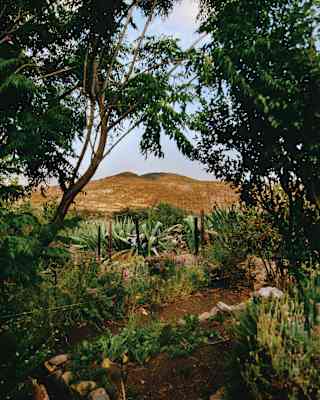
A view of a dry, brown hill framed by green trees, cacti, and various plants in the foreground under a partly cloudy sky.
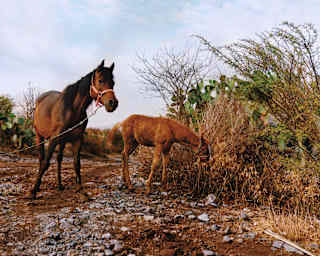
A brown horse stands on rocky ground holding a rope, whilst a foal grazes on dry shrubs nearby, under a cloudy sky with scattered green bushes around.

Time in El Bajío doesn’t pass; it collects. Not like quick dust, but like patient layers of stone, one atop another, pressed by habit and heat. (Exactly like the laja stone you’ll find at the end of the garambullo trail.) You don’t notice it until something breaks: a tile chipped in the kitchen, a song played too slowly, a pot that was never supposed to crack. People here don’t talk about time much, maybe because they already live inside it. They measure in seasons, in rains, in harvests, in weddings postponed and saints returned. A new dish is really an old one made during a different kind of hunger. Progress, if it arrives, shows up in a pickup truck, stays for lunch, and leaves before the coffee’s brewed. El Bajío, if it teaches anything, teaches you how to wait.  

I can’t recall if it was Borges (or maybe Mark Strand) who said that waiting is not an absence of movement, but the attention that makes movement meaningful. (I’m too old to Google that now.) It certainly sounds like something one of them would say, or should have said. To sit still, here, is to begin to understand that the centre is not a fixed point. It is a silence that feels familiar. A taste that doesn’t fade. And in El Bajío – like in that hallucinatory poem by Yeats – the centre cannot hold. Not right now. Maybe not ever. 

IN THIS STORY

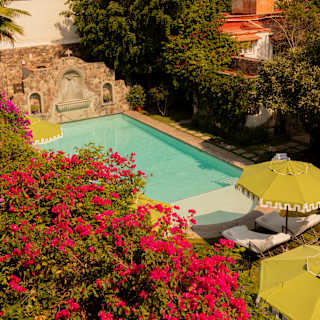
High-angle view over gardens, capturing red blooms, the serene swimming pool, and San Miguel Allende's pink church beyond.

Casa de Sierra Nevada

San Miguel de Allende, Mexico

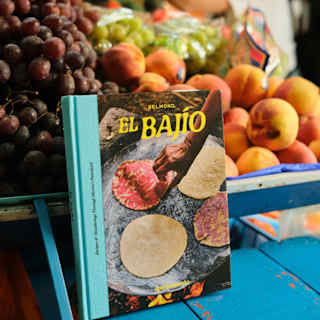
The El Bajío cookbook, with a cover photo of four heated tortillas, rests on a blue market table by an abundant fruit stall.

Recipes & Wanderings

Apartamento x Belmond

Author

Alonso Ruvalcaba is a taco-obsessed Mexican food critic and the co-author with Enrique Olvera of Sunny Days, Taco Nights, the ultimate insider’s guide to preparing and enjoying authentic tacos. Alonso has written about Mexican cuisine, heritage, and his love of tacos for major publications, including the Los Angeles Times, Bon Appétit, and Vice.