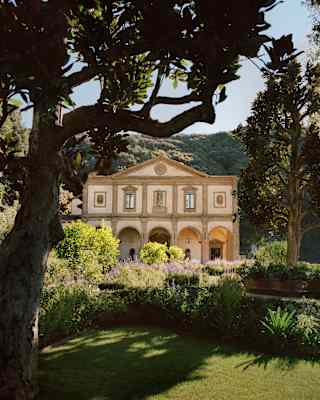
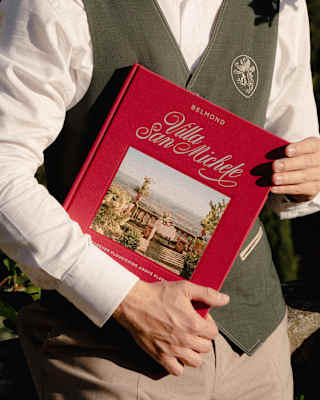
The story of Villa San Michele begins in 1411. Florence lay huddled within its defensive walls, its marble-clad Gothic cathedral still awaiting the Renaissance cupola that would later astonish the world. To the north, the old road to Fiesole wound steeply through shadowed woods into the cool breeze of the hills. It was along this ascent that Niccolò di Roberto de’ Davanzati – heir to a noble Florentine family whose palace still stands on Via Porta Rossa – acquired a small farm known as La Doccia, named after a spring, fed by the Affrico stream, that emerges from the rockface nearby. In a ritual from Roman law, the notary gathered earth, grass, and an olive branch from the land, laying them in Davanzati’s hands, binding soil to soul. Even today, the family’s coat of arms – a stone-carved lion rampant – watches over the entrance to San Michele.
Davanzati offered La Doccia to a local community of Franciscans, asking them to build a dormitory and an oratory where prayers for the salvation of his soul would rise like incense. In 1416, the oratory was adorned with a resplendent altarpiece: a Holy Trinity with Saints by Mariotto di Nardo, now in the Florentine Church of Santa Trinita, close to the Davanzati family chapel. Among the saints, Mariotto painted the archangel-warrior to whom the convent was dedicated: Saint Michael, guardian of thresholds, whose wings span heaven and earth, whose scales weigh souls at the Last Judgment.