Artist Mel Campion worked at Vanity Fair in her twenties before following the call of the sea and taking up the 17th-century practice of shell work. Her shell-encrusted mirrors for Britannic Explorer bring a briny, grotto-like feeling to the powder rooms on board. “Shells are sublime creations in their own right,” Campion explains: “There is a childlike sense of wonder in shells – they transport us instantly to beaches and seaside memories, with an almost spiritual quality. I like to work by the sea in my home on Holy Island off Anglesey, itself an island off the north Welsh coast. The soul and energy of the tides reside in the shell works, capturing the magic of the sea in an indoor setting.”
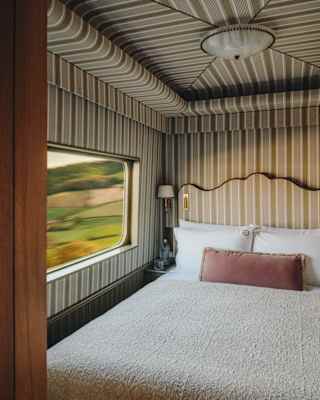
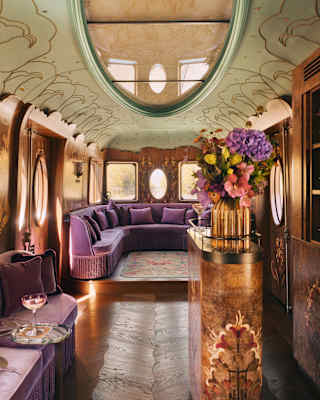
Campion refers to the natural textures of the shells in her framed mirrors as having an enlivening quality, playing with light and shadow as the train moves through the landscape and along the coast. It’s a subtle detail that might not be noticed in and of itself, but it’s an effect that is repeated in the multitude of material layers and details that make up the train interior. This is the power of craft, where textures – hammered, moulded, carved, hewn, embroidered, printed – combine to create a luxury train travel experience with tactile intrigue, bearing the hand of the maker and the imprint of their soul. It is the opposite of the efficient, industrial, municipal, value-engineered sterility that tends to dictate too many rail travel interiors. And it is a hallmark of Belmond’s genuine commitment to quality and cultural patronage.
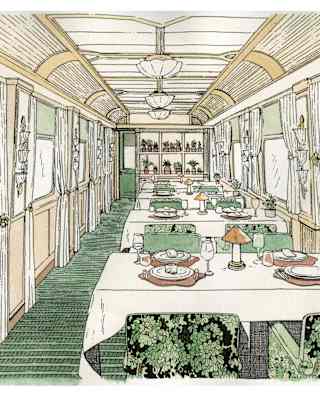
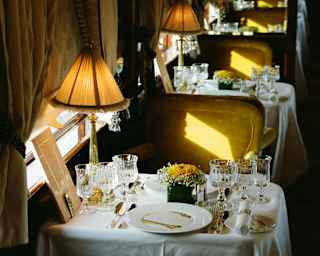
This is most explicit in the extensive collection of artwork onboard the Britannic Explorer. Curated by Studio Graphite, the approach has been to commission emerging artists whose work echoes and responds to nature. In the restaurant car, Cornish artist Adam Halls’ stitched textiles appear like large-scale compositions of lichen and algae. In the Grand Suite, Marcus James’ multicoloured pen drawings mirror mountainous regions with an abstracting intricacy, while Sarah Woods’ desaturated beach scenes in oil set a soothing scene in the spa.
The artwork of Olly Fathers features in three carriages, each a graphic composition made from different wood veneers that resemble mid-century marquetry. Fathers is inspired by movement in his work: “Trains have always been a big interest for me, so the commission for the Britannic Explorer was a very exciting opportunity,” he explains. “I’ve used some beautiful species of woods for these works, each with their own character: sycamore with an almost ripple effect; burr elm; some with a velvety patina. They change as you move past them. I hope they will draw people in to look a little more closely.”
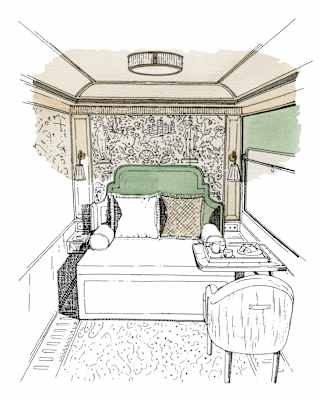
Artworks hang on wood-panelled walls throughout the luxury train, much as they would be presented in the home of a keen collector with a love for texture and a passion for the countryside. Indeed, for all that the interiors on board are sumptuous and magnificent, their overall effect is to connect guests to the landscapes beyond.
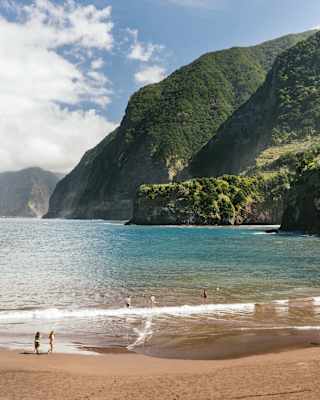
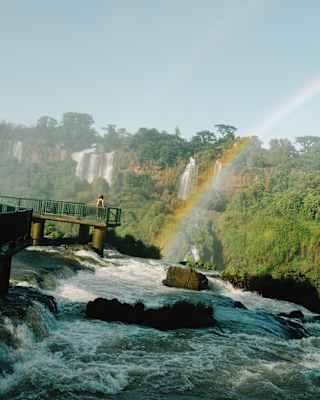
“We asked ourselves how we might embed the cultural and artistic traditions, materials and practices born from these landscapes within the design at every level,” explains Floyd. “In effect, these landscapes are the ever-changing wallpaper of the journey, so it is only fitting that the train interior becomes a showcase of all the beauty and skills we have in our hands and lands.” Such integration makes for an experience of extraordinary integrity, too.